Hello! Welcome to the Nandian Xuanfu Magistracy of the Culture & Tourism Bureau of Lianghe County CN/EN

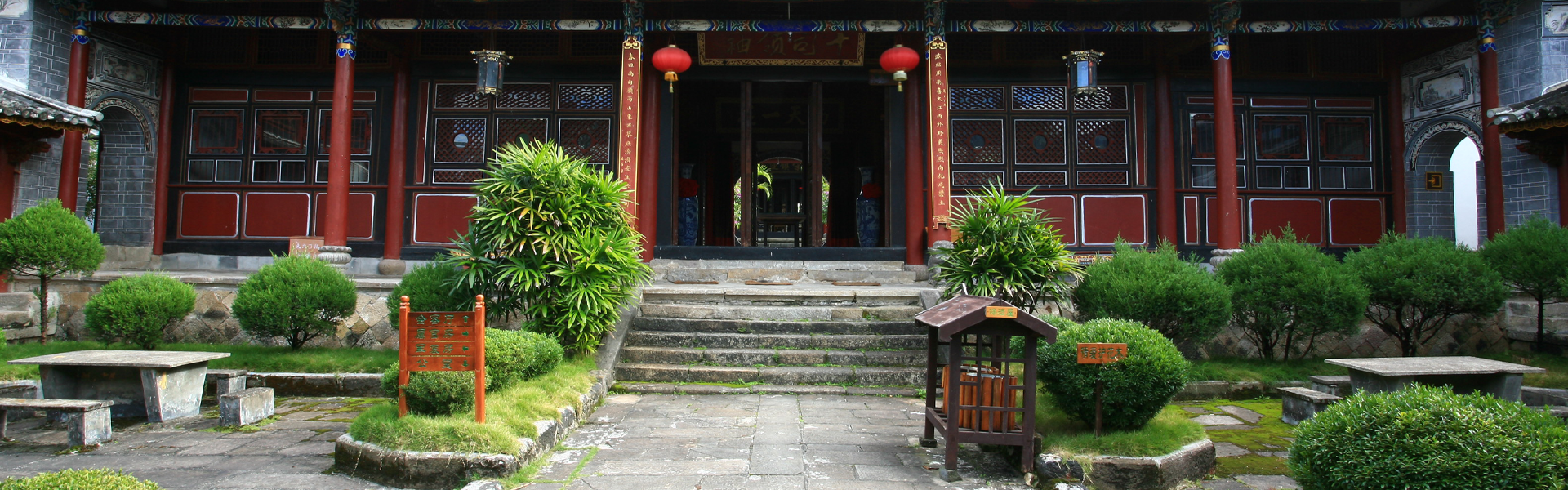
The Dai People's "Little Forbidden City"—Nandian Xuanfu Temple Office

The Nandian Xuanfu Office is currently the best-preserved Tusi administrative complex remaining in Yunnan. Located in Zhedao Town, Lianghe County seat, it was originally built in 1851 during the first year of the Qing Xianfeng reign. Over the course of three generations and with relentless effort spanning 84 years, the structure was finally completed in 1935.
The Nandian Xuanfu Temple Complex is laid out in the traditional Han-style administrative architecture, featuring a five-entry, four-courtyard design comprising 47 buildings with a total of 149 rooms. Spread across an area of over 10,000 square meters, the site is divided into functional zones befitting the hierarchical structure of a tusi (local chieftain) office—such as the Public Hall, Reception Room, Council Chamber, Main Hall, and Back Garden—all arranged in a progressively rising, five-entry, four-courtyard layout. This magnificent ancient architectural complex ranks among the most impressive tusi offices nationwide, earning it the nickname "Little Forbidden City" of the Dai people.
The so-called "sīshǔ" refers to an official government office—specifically, a yamen. In addition to its administrative offices, the "sīshǔ" also includes accommodations and other necessary ancillary buildings.
The Xuanfu Shi was a governing institution established by the central government in border regions during the feudal era, ranking second among the three levels of indigenous administrative officials—Xuanwei Shi, Xuanfu Shi, and Anfu Shi. As a military position, the Xuanfu Shi held immense authority over life and death, effectively functioning as a local "emperor" with near-complete control over his domain. Normally, the official rank of the Nandian Xuanfu Shi was seventh grade, equivalent to that of a county-level official. However, under special circumstances—such as hosting visiting officials or engaging in diplomatic exchanges with neighboring states—their rank could temporarily rise in accordance with their guests' titles, potentially reaching as high as fourth grade.


Office Address: No. 103 Nandian Road, Zhedao Town, Lianghe County
Customer Service Hotline:0692-6166603
Corporate email:1043492702@qq.com

Mobile app
Copyright: Lianghe County Culture and Tourism Bureau Technical Support:www.300.cn Kunming SEO